

Liposuction or Tummy Tuck: Which Procedure Do You Need?
A stubborn belly can be frustrating, especially when diet and exercise have already helped you lose weight but your abdomen still does not look the way you want.
You may notice excess fat around your waist, loose skin after weight loss, a protruding abdomen after pregnancy, or stretched skin that does not tighten on its own. At this point, two procedures often come into consideration: liposuction and tummy tuck surgery.
Although both can improve the appearance of the abdomen, they are designed to address different concerns.
Liposuction primarily removes localized deposits of excess fat, while a tummy tuck removes excess skin and may tighten weakened or separated abdominal muscles in addition to addressing some fat.
So, which one do you need?
The answer depends on what is causing the appearance of your abdomen, your skin quality, your body composition, your medical history, and your aesthetic goals.
If you are considering Tummy Tuck Surgery in Mumbai, understanding the difference between these procedures can help you have a more informed conversation with your plastic surgeon.
Liposuction vs Tummy Tuck: The Basic Difference
The simplest way to understand the two procedures is to consider what each one is designed to treat.
Liposuction
Liposuction is a body-contouring procedure that removes localized deposits of excess fat from specific areas.
It may be considered when:
- You have stubborn abdominal fat
- Your skin has relatively good elasticity
- You are close to your healthy or desired weight
- Diet and exercise have not eliminated certain fat deposits
- You want to improve body contours rather than remove excess skin
Liposuction does not primarily treat loose or hanging skin.
Tummy Tuck
A tummy tuck, also called abdominoplasty, is designed to address excess abdominal skin and can involve tightening weakened or separated abdominal muscles.
It may be considered when:
- You have significant loose abdominal skin
- Skin remains after major weight loss
- Pregnancy has stretched the abdominal tissues
- The abdominal wall has weakened or separated
- You have a lower abdominal skin fold
- Diet and exercise cannot correct the excess skin
A tummy tuck can reshape the abdomen by removing excess skin and addressing underlying tissue when appropriate.
Why the Difference Matters
Imagine two people with similar-looking stomachs.
The first person has firm skin but a localized pocket of fat around the lower abdomen. Their main concern is excess fat.
The second person has relatively little excess fat but has loose, stretched skin hanging over the lower abdomen following pregnancy or significant weight loss.
They may appear to have the same problem, but the appropriate treatment can be completely different.
The first person may benefit from liposuction.
The second person may need a tummy tuck.
This is why choosing a procedure based only on photographs or another person's results is not advisable.
When Is Liposuction a Better Option?
Liposuction may be suitable when excess fat is the primary concern and the skin has enough elasticity to contract reasonably well after fat removal.
Common areas treated with liposuction can include:
- Abdomen
- Waist
- Flanks
- Hips
- Thighs
- Back
- Other localized areas
For abdominal contouring, the surgeon removes fat through small incisions using specialized instruments.
The goal is to improve the contour rather than simply remove as much fat as possible.
Good Skin Elasticity Is Important
Skin elasticity is a key factor when considering liposuction.
When fat is removed, the skin needs to adapt to the new underlying contour.
If the skin has good elasticity, it may contract relatively well.
If the skin is significantly stretched or loose, removing the underlying fat alone may leave excess skin behind.
In that situation, a tummy tuck may be more appropriate.
When Is a Tummy Tuck a Better Option?
A tummy tuck may be more suitable when loose skin is a major concern.
This is particularly common after:
- Pregnancy
- Significant weight loss
- Multiple pregnancies
- Major changes in body weight
- Aging-related loss of skin elasticity
The procedure can remove excess abdominal skin and reshape the remaining tissue.
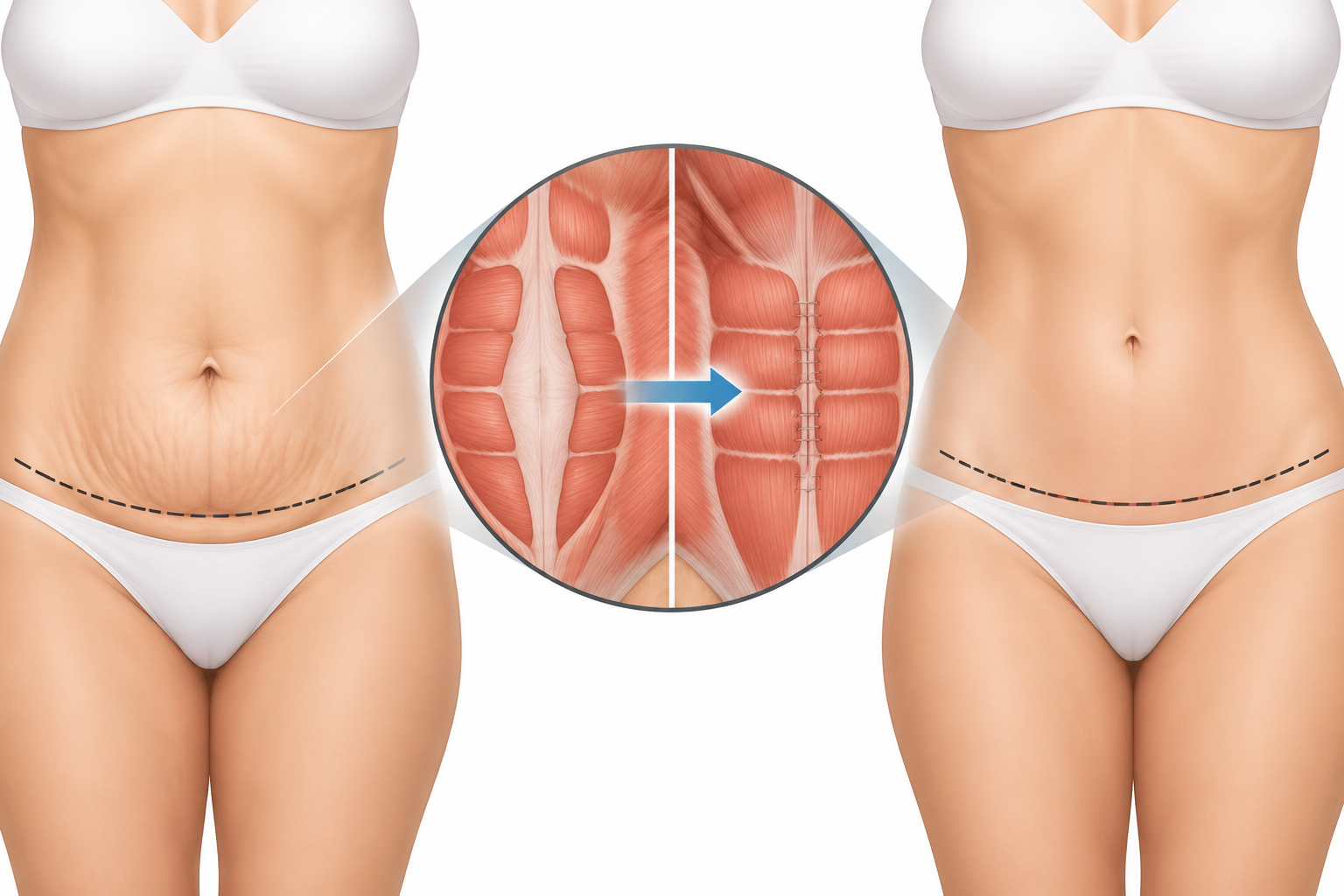
In appropriate patients, the abdominal muscles may also be repaired or tightened if they have become weakened or separated.
What Is Muscle Repair During a Tummy Tuck?
The abdominal wall consists of muscles and connective tissues that support the core and abdominal organs.
Pregnancy and significant weight changes can stretch the tissues between the abdominal muscles.
Some patients develop a condition called diastasis recti, where the abdominal muscles become separated along the midline.
A tummy tuck can include repair of this separation when clinically appropriate.
This is different from simply removing fat.
Liposuction does not repair separated abdominal muscles.
Therefore, if abdominal wall laxity is contributing to the appearance of a protruding stomach, liposuction alone may not address the underlying concern.
Can Liposuction and Tummy Tuck Be Combined?
In selected patients, yes.
Some people have both excess abdominal fat and loose skin.
In such cases, combining liposuction with a tummy tuck may provide more comprehensive contouring.
Liposuction can address localized fat deposits, while the tummy tuck addresses excess skin and, when appropriate, abdominal wall laxity.
However, combining procedures is not automatically the best choice for everyone.
The decision depends on your health, anatomy, the amount of tissue involved, surgical goals, and overall safety.
Your surgeon should determine whether combining procedures is appropriate for you.
What Happens During a Tummy Tuck?
The exact technique varies according to the patient's anatomy and the amount of excess skin.
Generally, the surgeon makes an incision in the lower abdomen, removes excess skin, and reshapes the abdominal tissues.
If muscle separation or abdominal wall laxity is present and repair is appropriate, the surgeon may tighten the abdominal wall.
The remaining skin is then repositioned and closed.
The belly button may also need to be repositioned depending on the extent of surgery.
The result is intended to create a smoother and more proportionate abdominal contour.
What Happens During Liposuction?
During liposuction, small incisions are made in the treatment area.
A thin cannula is then used to remove targeted fat deposits.
The surgeon carefully contours the area rather than simply removing a large amount of fat.
Liposuction is therefore best understood as a body-contouring procedure, not a weight-loss treatment.
Liposuction vs Tummy Tuck: Key Differences
| Feature | Liposuction | Tummy Tuck |
|---|---|---|
| Primary purpose | Removes localized fat | Removes excess skin and reshapes abdomen |
| Loose skin | Limited effect | Specifically addresses excess skin |
| Muscle repair | No | May be performed when appropriate |
| Best suited for | Localized fat with good skin elasticity | Loose skin, stretched tissues, abdominal laxity |
| Incisions | Usually smaller | Larger lower-abdominal incision |
| Scarring | Generally smaller scars | More extensive scar |
| Recovery | Generally shorter | Generally longer |
| Weight loss procedure | No | No |
| Can be combined? | Yes, in selected cases | Can be combined with liposuction in selected patients |
Can Liposuction Remove Loose Skin?
Not effectively.
This is one of the most important points to understand.
Liposuction removes fat underneath the skin. It does not remove significant amounts of excess skin.
If the skin has lost substantial elasticity, removing fat may actually make the loose skin more noticeable.
Some skin contraction may occur after liposuction, particularly in people with good skin elasticity, but this should not be confused with surgical skin removal.
If significant excess skin is present, a tummy tuck may provide a more appropriate solution.
Can a Tummy Tuck Remove Fat?
A tummy tuck can remove some excess fat along with the skin, depending on the surgical plan.
However, it is not primarily a fat-removal procedure.
If substantial localized fat is present around the abdomen or flanks, liposuction may be considered as part of the overall contouring plan.
The combination of procedures may be appropriate in selected patients.
What If You Have a Belly After Pregnancy?
Pregnancy can change the abdomen in several ways.
You may experience:
- Stretched skin
- Stretch marks
- Localized fat
- Abdominal muscle separation
- Changes in the position of the belly button
- Reduced skin elasticity
Because multiple issues can occur at the same time, a tummy tuck is sometimes considered after pregnancy when excess skin and abdominal wall changes are significant.
Liposuction may address localized fat, but it cannot remove substantial loose skin or repair muscle separation.
If you are planning another pregnancy, discuss this with your surgeon before considering surgery.
What If You Have Lost a Lot of Weight?
Significant weight loss is an important reason some people consider tummy tuck surgery.
After major weight loss, the body may have considerably less fat but still have loose skin that does not retract adequately.
This can occur around the:
- Abdomen
- Waist
- Lower back
- Arms
- Thighs
When excess abdominal skin remains despite reaching a stable weight, a tummy tuck may be considered.
It is generally preferable to undergo body-contouring surgery once your weight has stabilized rather than while you are still actively losing a significant amount of weight.
Can Exercise Give You the Same Result?
Exercise can strengthen abdominal muscles and help reduce overall body fat, but it cannot always remove significant excess skin.
Similarly, diet and exercise may reduce body fat but cannot selectively eliminate one specific fat deposit.
This is where body-contouring procedures can play a role for carefully selected patients.
However, neither liposuction nor tummy tuck should replace a healthy lifestyle.
Is a Tummy Tuck a Weight-Loss Procedure?
No.
A tummy tuck is primarily a body-contouring procedure.
Although some tissue is removed during surgery, it should not be considered an alternative to weight loss.
The best candidates are generally those who are relatively close to their desired or stable weight but have concerns such as excess abdominal skin or abdominal wall laxity.
Significant weight fluctuations after surgery can affect the result.
How Do You Know Which Procedure You Need?
Consider the following questions.
Is your main concern fat?
If you have localized fat deposits but relatively firm skin, liposuction may be worth discussing.
Is your main concern loose skin?
If you have significant excess skin that folds or hangs, a tummy tuck may be more appropriate.
Do you have both?
If you have both excess fat and loose skin, a combination of liposuction and tummy tuck may be considered.
Do you have abdominal muscle separation?
If abdominal wall separation is present, liposuction alone will not repair it. A tummy tuck may be considered when muscle repair is appropriate.
Have you recently lost significant weight?
If you have loose skin remaining after major weight loss, a tummy tuck may be more suitable than liposuction alone.
What Is Recovery Like?
Recovery differs between the two procedures.
After Liposuction
Patients may experience:
- Swelling
- Bruising
- Tenderness
- Temporary numbness
- Fluid retention
Compression garments may be recommended, and strenuous activity may need to be restricted for a period of time.
After Tummy Tuck
Recovery generally involves more extensive healing.
You may experience:
- Swelling
- Tightness
- Bruising
- Discomfort around the abdomen
- Temporary limitations on movement
- A need to avoid strenuous activity initially
Your surgeon will provide individualized instructions regarding wound care, activity, sleeping position, compression garments, and return to work and exercise.
Do not compare your recovery timeline directly with someone else's.
What About Scarring?
Scarring is an important consideration for tummy tuck surgery.
Because excess skin needs to be removed, a longer incision is usually required.
The scar is typically positioned as low as reasonably possible so that it can be concealed beneath underwear or swimwear, but its final appearance varies from person to person.
Liposuction generally involves smaller access incisions.
However, the final scars depend on the surgical technique, healing response, genetics, and aftercare.
How Long Do the Results Last?
Both procedures can provide long-lasting contour improvements, particularly when patients maintain a relatively stable weight.
However, neither procedure stops the natural aging process.
Significant weight gain or loss, pregnancy, and changes in skin elasticity can alter the appearance of the abdomen over time.
Maintaining a healthy lifestyle and stable weight can help preserve the results.
Questions to Ask During Your Consultation
If you are considering Tummy Tuck Surgery in Mumbai, ask your surgeon:
- Is my main concern excess fat, loose skin, or both?
- Would liposuction alone address my concerns?
- Do I have abdominal muscle separation?
- Would a tummy tuck be more appropriate?
- Could both procedures be safely combined?
- Where would my surgical scars be located?
- How long should I expect recovery to take?
- When can I return to exercise?
- How will pregnancy or future weight changes affect the result?
- What outcome can I realistically expect?
A detailed consultation can help you understand the differences and avoid choosing a procedure based only on price or someone else's experience.
Frequently Asked Questions
Is liposuction better than a tummy tuck?
Neither procedure is universally better. Liposuction is designed primarily for localized fat, while a tummy tuck addresses excess skin and may address abdominal muscle separation. The appropriate procedure depends on your individual concerns.
Can liposuction give me a flat stomach?
Liposuction can improve abdominal contours when excess localized fat is the primary issue. However, it cannot reliably remove significant loose skin or repair abdominal muscle separation.
Does a tummy tuck remove more fat than liposuction?
Not necessarily. Liposuction is specifically designed to remove localized fat, while a tummy tuck focuses primarily on excess skin and abdominal contouring.
Can I have liposuction without a tummy tuck?
Yes. Patients with localized fat and relatively good skin elasticity may be suitable candidates for liposuction alone.
Can I have a tummy tuck without liposuction?
Yes. If excess skin and abdominal laxity are the primary concerns and significant fat removal is not needed, a tummy tuck may be performed without liposuction.
Which procedure has a longer recovery?
A tummy tuck generally involves a more extensive recovery than liposuction because it involves skin removal and may involve abdominal muscle repair.
Can a tummy tuck remove stretch marks?
Some stretch-marked skin may be removed along with excess lower abdominal skin. However, not all stretch marks can be eliminated, particularly those located above the area of skin being removed.
Will my stomach become completely flat after surgery?
Results vary. Surgery can improve abdominal contour, but the final outcome depends on your anatomy, skin quality, muscle condition, body weight, and healing. A surgeon should discuss realistic expectations rather than guarantee a perfectly flat abdomen.
When is the right time to consider a tummy tuck?
Ideally, you should be at or near a stable weight and have realistic expectations about the procedure. If you are planning significant weight loss or pregnancy, discuss your timeline with your surgeon before scheduling surgery.
Final Thoughts
Liposuction and tummy tuck surgery can both improve abdominal contours, but they solve different problems.
If localized fat is the main concern and your skin has good elasticity, liposuction may be sufficient. If loose skin, stretched abdominal tissues, or muscle separation are the primary concerns, a tummy tuck may be more appropriate. When both excess fat and loose skin are present, combining the procedures may be considered in selected patients.
The most important step is to determine what is actually causing the appearance you want to change.
Considering Tummy Tuck Surgery in Mumbai?
If you're unsure whether liposuction, a tummy tuck, or a combination approach is right for you, Dr. Vinay Jacob can assess your abdominal skin, fat distribution, muscle condition, body weight, and aesthetic goals.
Book a consultation in Mumbai to understand your options and develop a personalized treatment plan focused on achieving a smoother, more proportionate abdominal contour.