

One Dimple or Two? How to Decide What Suits Your Face
Dimples are often associated with a distinctive smile and a youthful facial appearance. While some people naturally have one dimple and others have two, it is also possible to create dimples through a cosmetic procedure known as dimpleplasty or dimple creation surgery.
One of the first decisions people make when considering the procedure is whether to create a single dimple on one cheek or matching dimples on both cheeks. Although both options can produce attractive results, the right choice depends on facial proportions, cheek anatomy, smile patterns, and personal aesthetic preferences.
For individuals considering Dimple Creation Surgery in Mumbai, understanding the differences between one and two dimples can help make the consultation more productive and ensure that the planned result complements their natural features.
What Is Dimple Creation Surgery?
Dimple creation surgery is a cosmetic procedure designed to create an indentation in the cheek. It is commonly performed through a small incision inside the mouth, allowing the surgeon to create a connection between the underlying tissue and the skin.
When the cheek muscles move during smiling, this connection pulls the skin inward, producing the appearance of a dimple.
The procedure is generally performed under local anaesthesia and does not usually require an external skin incision. However, the technique, healing process, and final appearance can vary depending on the patient's anatomy and the surgeon's approach.
The goal is to create a dimple that looks harmonious with the person's face rather than an indentation that appears artificial or excessively deep.
One Dimple vs Two Dimples: What Is the Difference?
Both options can enhance the appearance of a smile, but they create different visual effects.
Choosing One Dimple
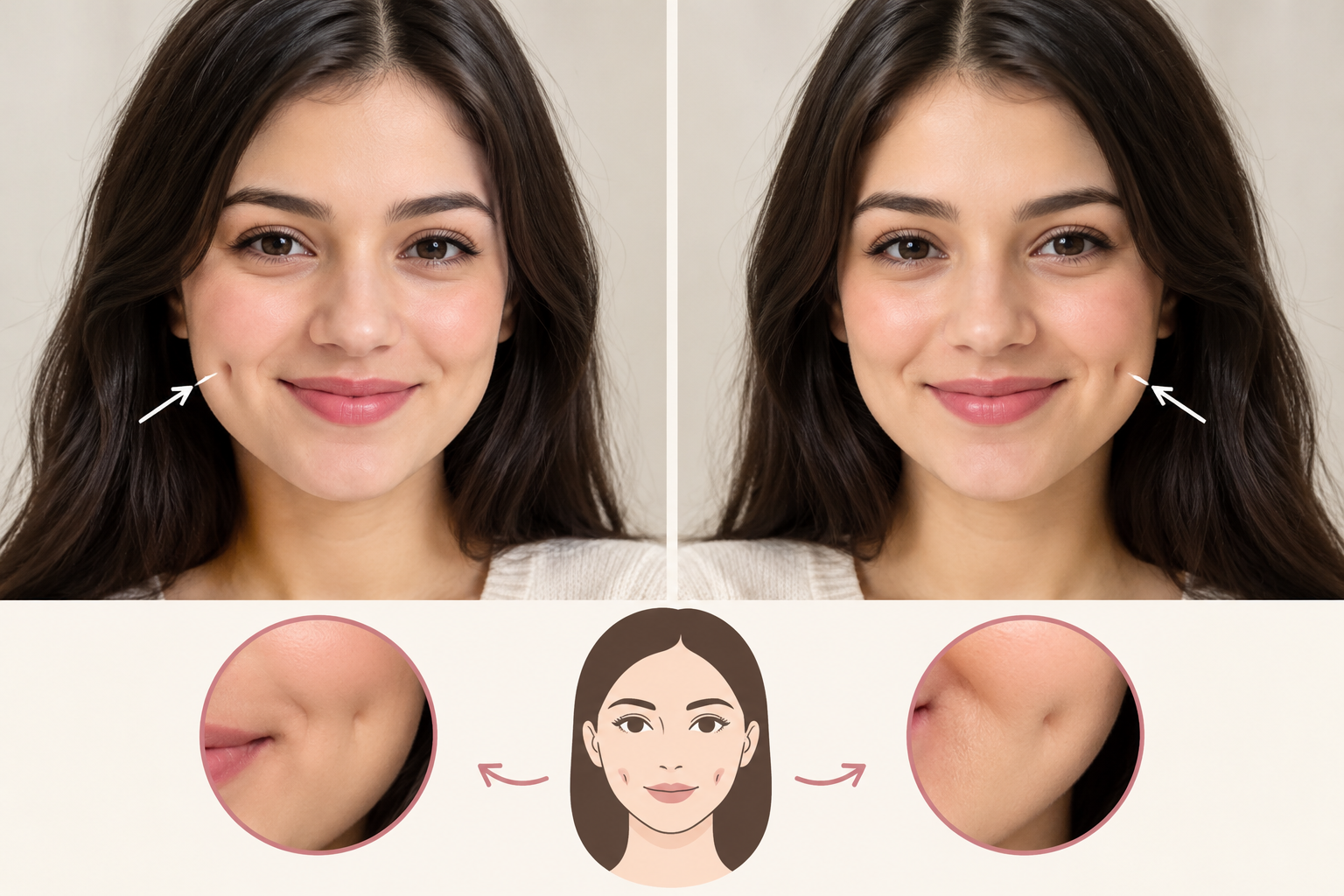
A single dimple creates an asymmetrical facial feature. Some people naturally prefer this look because it adds a distinctive detail to their smile without creating matching indentations on both cheeks.
One dimple may appeal to people who:
- Prefer a subtle or distinctive facial feature
- Like the appearance of natural one-sided dimples
- Want a less symmetrical aesthetic
- Prefer to create an indentation on one particular cheek
However, a single dimple does not automatically look more natural or subtle than two dimples. Its appearance depends on the chosen location, depth, facial proportions, and smile dynamics.
Choosing Two Dimples
Two dimples create indentations on both cheeks, often producing a more balanced appearance when smiling.
This option may appeal to people who:
- Prefer a symmetrical-looking smile
- Like the appearance of dimples on both cheeks
- Want a more noticeable dimple effect
- Prefer a matching feature on either side of the face
Perfect symmetry is not always possible because natural facial anatomy varies from one side to the other. The aim is to create a balanced result that works with the person's existing features.
How Do You Decide Whether One or Two Dimples Suit Your Face?
There is no universal rule that determines whether one or two dimples will look better. A personalized assessment can help identify which option may suit your facial structure and preferences.
1. Consider Your Natural Facial Symmetry
Everyone has some degree of facial asymmetry. One cheek may be fuller, one side of the smile may rise slightly higher, or the jawline may differ subtly between sides.
These differences can influence how a surgically created dimple appears.
If you prefer a single dimple, the surgeon can assess which cheek may be more suitable based on your facial anatomy and smile.
If you prefer two dimples, both sides should be evaluated individually rather than assuming that identical placement will produce perfectly matching results.
2. Look at Your Smile Pattern
Your smile plays an important role in how dimples appear.
Some people show more cheek movement on one side, while others have a relatively symmetrical smile.
During a consultation, the surgeon may assess your face at rest and during different expressions to understand how the cheeks move.
This helps guide placement and may reduce the likelihood of a dimple looking misplaced when you smile naturally.
3. Consider Your Cheek Shape
Cheek fullness and underlying tissue structure can influence the appearance of a dimple.
A dimple created on a fuller cheek may look different from one created on a slimmer cheek. Skin thickness, soft tissue, and muscle movement also affect the result.
People with different facial structures can still be candidates for dimple creation, but the surgical plan should be tailored to the individual.
4. Decide How Noticeable You Want the Result to Be
Your preferred aesthetic outcome is an important part of the decision.
Some people prefer a small indentation that becomes visible mainly when smiling. Others prefer a more noticeable dimple.
However, the number of dimples alone does not determine how prominent the result will be. Depth, location, tissue characteristics, and healing all play a role.
Discussing your preferences clearly with the surgeon can help establish realistic expectations.
5. Think About Your Overall Facial Proportions
A dimple should complement the face rather than compete with other features.
The surgeon may consider the relationship between the cheeks, lips, corners of the mouth, jawline, and smile.
For some individuals, a single dimple may create the distinctive appearance they want. For others, two dimples may better match their preferred look.
There is no fixed facial shape that requires one option over the other.
6. Understand That Symmetry Does Not Guarantee Naturalness
Two dimples may appear balanced, but naturalness depends on more than symmetry.
If both dimples are too deep, too low, or poorly positioned, the result may look artificial.
Similarly, a single dimple can look natural when it follows the person's facial anatomy and smile pattern.
The most suitable option is the one that complements your individual features and meets your aesthetic goals.
Can You Choose Which Cheek Gets the Dimple?
Yes. During a consultation for single-dimple creation, you can discuss whether you prefer the left or right cheek.
The surgeon will assess the proposed location in relation to your smile, cheek shape, and facial proportions.
Your preference is important, but the final surgical plan should also take anatomical factors into account.
It is useful to discuss the intended location while looking at your face both at rest and while smiling.
What Happens During Dimple Creation Surgery?
Although techniques differ, the procedure generally follows a few key steps.
Step 1: Consultation and Planning
The surgeon reviews your medical history, examines your facial structure, and discusses whether you prefer one or two dimples.
The intended location and appearance are planned before the procedure.
Step 2: Local Anaesthesia
Local anaesthesia is generally used to numb the treatment area.
This helps keep the procedure comfortable while allowing the surgeon to work on the cheek tissue.
Step 3: Small Internal Incision
A small incision is made inside the cheek. This approach generally avoids a visible external facial scar.
Step 4: Creating the Dimple
The surgeon creates a controlled connection between the deeper cheek tissue and the underside of the skin, usually using an internal suture or a related tissue-approximation technique.
This connection creates the indentation when the cheek moves.
Step 5: Closing the Incision
The internal incision is closed with appropriate sutures, and the patient receives instructions for oral hygiene, eating, and recovery.
The procedure is usually performed as an outpatient treatment, subject to the surgeon's assessment.
Does Dimple Creation Surgery Look Natural?
A natural-looking result depends on several factors, including:
- Appropriate dimple placement
- Suitable depth and size
- Individual cheek anatomy
- Natural movement during smiling
- The surgical technique
- Healing and tissue response
A newly created dimple may initially appear deeper than expected because of swelling and the early healing process.
The appearance can change over the following weeks and months. Some dimples become less prominent when the face is relaxed, while others remain more visible.
It is important to understand that the final result cannot be predicted with complete certainty.
Can You Change Your Mind About One or Two Dimples Later?
Dimple creation is intended to produce a long-lasting change. Changing the result later may be difficult, and revision does not guarantee that the original appearance can be restored.
For this reason, it is worth taking time to consider whether you prefer one or two dimples before proceeding.
During the consultation, discuss the intended position, depth, symmetry, and possible long-term changes.
Do not choose an option solely because it is currently popular or because it looks good on another person. A result that suits someone else's facial structure may not suit yours.
Recovery After Dimple Creation Surgery
Recovery varies between individuals, but the procedure is generally less extensive than many other facial surgeries.
First Few Days
Mild swelling, tenderness, and discomfort may occur. The dimples may appear deeper or more prominent than expected.
Your surgeon may recommend softer foods temporarily and provide specific instructions for cleaning your mouth and caring for the treated area.
First Few Weeks
Swelling generally begins to settle, and the appearance may gradually change.
The dimple may remain visible when your face is relaxed during early healing. This does not necessarily indicate the final result.
Longer-Term Healing
The internal tissues continue to heal and remodel over time. The final appearance depends on the surgical technique and individual tissue response.
Follow-up appointments help the surgeon assess healing and address any concerns.
What Are the Risks of Dimple Creation Surgery?
Dimple creation is a cosmetic procedure, and complications are possible even when it is performed by an experienced surgeon.
Potential risks include:
- Infection
- Bleeding
- Swelling and discomfort
- Uneven dimples
- Excessive or insufficient depth
- Changes in the appearance during healing
- Persistent indentation when the face is relaxed
- Unfavourable cosmetic results
- The need for revision
Because the incision is inside the mouth, appropriate oral hygiene and adherence to postoperative instructions are important.
Discuss the possible complications and limitations with your surgeon before deciding to proceed.
Questions to Ask Before Choosing One or Two Dimples
A consultation is an opportunity to clarify your goals and understand what may be achievable.
Consider asking:
- 1. Would one or two dimples complement my facial structure?
- 2. Where would the dimple or dimples be positioned?
- 3. How might my smile affect the final appearance?
- 4. Can the dimples remain visible when my face is relaxed?
- 5. How might swelling affect the early result?
- 6. What complications should I understand before surgery?
- 7. How long should I allow for recovery?
- 8. What options would be available if the result is not what I expected?
These questions can help you make an informed decision rather than focusing only on the number of dimples.
Frequently Asked Questions
- Is one dimple better than two?
Neither option is universally better. The right choice depends on your facial proportions, smile pattern, personal preference, and the result you want to achieve. - Do two dimples always look more symmetrical?
Two dimples are intended to create a balanced appearance, but exact symmetry cannot be guaranteed. Natural differences between the cheeks and individual healing can influence the outcome. - Can I choose the exact location of my dimple?
You can discuss your preferred location with the surgeon. The final position should also account for facial anatomy, cheek movement, and the intended appearance. - Will my dimples be visible when I am not smiling?
This varies between individuals. Newly created dimples may initially remain visible at rest, but their appearance can change as healing progresses. - Is dimple creation surgery permanent?
The procedure is intended to create a long-lasting change, but the depth and visibility of the dimples may change over time. Revision can be difficult, so careful planning is important. - How long does recovery take after dimple creation?
Initial recovery is generally relatively short, although swelling and changes in appearance may continue for several weeks or longer. Follow your surgeon's instructions and attend recommended follow-up appointments. - Can I have only one dimple if I naturally have none?
Yes. Dimple creation surgery can be performed on one cheek or both, depending on your preference and whether the procedure is appropriate for your anatomy.
Considering Dimple Creation Surgery in Mumbai?
Choosing between one dimple and two is a personal decision, but careful planning can help ensure that the intended result complements your natural facial features.
If you are considering Dimple Creation Surgery in Mumbai, Dr. Vinay Jacob can assess your cheek anatomy, smile pattern, and aesthetic preferences to discuss a suitable surgical approach.
During your consultation, you can explore the differences between single- and double-dimple creation, understand the expected recovery, and discuss the potential risks and limitations.
Book a consultation with Dr. Vinay Jacob in Mumbai to discuss your dimple creation goals and determine which option may suit your facial features.